

The Light Course
GA 320
Lecture II
24 December 1919, Stuttgart
My dear Friends,
Yesterday I was saying how in our study of Nature we have upon the one hand the purely kinematical, geometrical and arithmetical truths,—truths we are able to gain simply from our own life of thought. We form our thoughts about all that, which in the physical processes around us can be counted, or which is spatial and kinematical in form and movement. This we can spin, as it were, out of our own life of thought. We derive mathematical formulae concerning all that can be counted and computed or that is spatial in form and movement, and it is surely significant that all the truths we thus derive by thought also prove applicable to the processes of Nature. Yet on the other hand it is no less significant that we must have recourse to quite external experiences the moment we go beyond what can be counted and computed or what is purely spatial or kinematical. Indeed we need only go on to the realm of Mass, for it to be so.
In yesterday's lecture we made this clear to ourselves. While in phoronomy we can construct Nature's processes in our own inner life, we now have to leap across into the realm of outer, empirical, purely physical experience. We saw this pretty clearly in yesterday's lecture, and it emerged that modern Physics does not really understand what this leap involves. Till we take steps to understand it, it will however be quite impossible ever to gain valid ideas of what is meant or should be meant by the word “Ether” in Physics. As I said yesterday, present-day Physics (though now a little less sure in this respect) still mostly goes on speaking for example of the phenomena of light and colour rather as follows:—We ourselves are affected, say, by an impression of light or colour—we, that is, as beings of sense and nerve, or even beings of soul. This effect however is subjective. The objective process, going on outside in space and time, is a movement in the ether. Yet if you look it up in the text-books or go among the physicists to ascertain what ideas they have about this “ether” which is supposed to bring about the phenomena of light, you will find contradictory and confused ideas. Indeed, with the resources of Physics as it is today it is not really possible to gain true or clear ideas of what deserves the name of “ether”.
We will now try to set out upon the path that can really lead to a bridging of the gulf between phoronomy and even only mechanics,—inasmuch as mechanics already has to do with forces and with masses. I will write down a certain formula, putting it forward today simply as a well-known theorem. (We can go into it again another time so that those among you who may no longer recall it from your school days can then revise what is necessary for the understanding of it. Now I will simply adduce the essential elements to bring the formula before your minds.)
Let us suppose, first in the sense of pure kinematics, that a point (in such a case we always have to say, a point) is moving in a certain direction. For the moment, we are considering the movement pure and simple, not its causes. The point will be moving more or less quickly or slowly. We say it moves with a greater or lesser “velocity”. Let us call the velocity \(v\). This velocity, once more, may be greater or it may be smaller. So long as we go no farther than to observe that the point moves with such and such velocity, we are in the realm of pure kinematics. But this would not yet lead us to real outer Nature,—not even to what is mechanical in Nature. To approach Nature we must consider how the point comes to be moving. The moving object cannot be the mere thought of a point. Really to move, it must be something in outer space. In short, we must suppose a force to be acting on the point. I will call \(v\) the velocity and \(p\) the force that is acting on the point. Also we will suppose the force not only to be working instantaneously,—pressing upon the point for a single moment which of course would also cause it to move off with a certain velocity if there were no hindrance—but we will presuppose that the force is working continuously, so that the same force acts upon the point throughout its path. Let us call \(s\) the length of the path, all along which the force is acting on the point. Finally we must take account of the fact that the point must be something in space, and this “something” may be bigger or it may be smaller; accordingly, we shall say that the point has a greater or lesser mass. We express the mass, to begin with, by a weight. We can weigh the object which the force is moving and express the mass of it in terms of weight. Let us call the mass, \(m\).
Now if the force \(p\) is acting on the mass \(m\), a certain effect will of course be produced. The effect shows itself, in that the mass moves onward not with uniform speed but more and more quickly. The velocity gets bigger. This too we must take into account; we have an ever growing velocity, and there will be a certain measure of this increase of velocity. A smaller force, acting on the same mass, will also make it move quicker and quicker, but to a lesser extent; a larger force, acting on the same mass, will make it move quicker more quickly. We call the rate of increase of velocity the acceleration; let us denote the acceleration by \(g\). Now what will interest us above all is this:—(I am reminding you of a formula which you most probably know; I only call it to your mind.) Multiply the force which is acting on the given mass by the length of the path, the distance through which it moves; then the resulting product is equal to,—i.e. the same product can also be expressed by multiplying the mass by the square of the eventual velocity and dividing by 2. That is to say:
$$ps=\frac{mv^2}{2}$$Look at the right-hand side of this formula. You see in it the mass. You see from the equation: the bigger the mass, the bigger the force must be. What interests us at the moment is however this:—On the right-hand side of the equation we have mass, i.e. the very thing we can never reach phoronomically. The point is: Are we simply to confess that whatever goes beyond the phoronomical domain must always be beyond our reach, so that we can only get to know it, as it were, by staring at it,—by mere outer observation? Or is there after all perhaps a bridge—the bridge which modern Physics cannot find—between the phoronomical and the mechanical?
Physics today cannot find the transition, and the consequences of this failure are immense. It cannot find it because it has no real human science,—no real physiology. It does not know the human being. You see, when I write \(v^2\), therein I have something altogether contained within what is calculable and what is spatial movement. To that extent, the formula is phoronomical. When I write \(m\) on the other hand, I must first ask: Is there anything in me myself to correspond also to this,—just as my idea of the spatial and calculable corresponds to the \(v\)? What corresponds then to the \(m\)? What am I doing when I write the \(m\)? The physicists are generally quite unconscious of what they do when they write m. This then is what the question amounts to: Can I get a clear intelligible notion of what the \(m\) contains, as by arithmetic, geometry and kinematics I get a clear intelligible notion of what the \(v\) contains? The answer is, you can indeed, but your first step must be to make yourself more consciously aware of this:—Press with your finger against something: you thus acquaint yourself with the simplest form of pressure. Mass, after all, reveals itself through pressure. As I said just now, you realize the mass by weighing it. Mass makes its presence known, to begin with, simply by this: by its ability to exert pressure. You make acquaintance with pressure by pressing upon something with your finger. Now we must ask ourselves: Is there something going on in us when we exert pressure with our finger,—when we, therefore, ourselves experience a pressure—analogous to what goes on in us when we get the clear intelligible notion, say, of a moving body? There is indeed, and to realize what it is, try making the pressure ever more intense. Try it,—or rather, don't! Try to exert pressure on some part of your body and then go on making it ever more intense. What will happen? If you go on long enough you will lose consciousness. You may conclude that the same phenomenon—loss of consciousness—is taking place, so to speak, on a small scale when you exert a pressure that is still bearable. Only in that case you lose, a little of the force of consciousness that you can bear it. Nevertheless, what I have indicated—the loss of consciousness which you experience with a pressure stronger than you can endure—is taking place partially and on a small scale whenever you come into any kind of contact with an effect of pressure—with an effect, therefore, which ultimately issues from some mass.
Follow the thought a little farther and you will no longer be so remote from understanding what is implied when we write down the \(m\). All that is phoronomical unites, as it were, quite neutrally with our consciousness. This is no longer so when we encounter what we have designated \(m\). Our consciousness is dimmed at once. If this only happens to a slight extent we can still bear it; if to a great extent, we can bear it no longer. What underlies it is the same in either case. Writing down \(m\), we are writing down that in Nature which, if it does unite with our consciousness, eliminates it,—that is to say, puts us partially to sleep. You see then, why it cannot be followed phoronomically. All that is phoronomical rests in our consciousness quite neutrally. The moment we go beyond this, we come into regions which are opposed to our consciousness and tend to blot it out. Thus when we write down the formula
$$ps=\frac{mv^2}{2}$$we must admit: Our human experience contains the \(m\) no less than the \(v\), only our normal consciousness is not sufficient here,—does not enable us to seize the \(m\). The \(m\) at once exhausts, sucks out, withdraws from us the force of consciousness. Here then you have the real relationship to man. To understand what is in Nature, you must bring in the states of consciousness. Without recourse to these, you will never get beyond what is phoronomical,—you will not even reach the mechanical domain.
Nevertheless, although we cannot live with consciousness in all that, for instance, which is implied in the letter \(m\), yet with our full human being we do live in it after all. We live in it above all with our Will. And as to how we live in Nature with our Will,—I will now try to illustrate it with an example. Once more I take my start from some-thing you will probably recall from your school-days; I have no doubt you learned it.
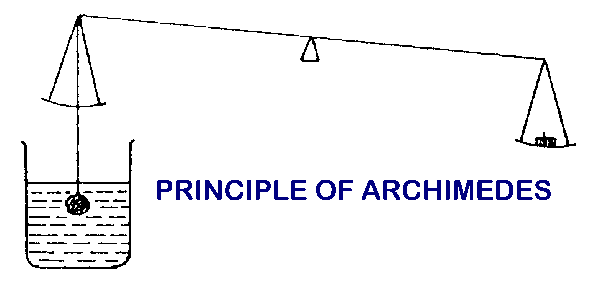
Here is a balance (Figure IIa). I can balance the weight that is on the one side with an object of equal weight, suspended this time, at the other end of the beam. We can thus weigh the object; we ascertain its weight. We now put a vessel there, filled up to here with water, so that the object is submerged in water. Immediately, the beam of the balance goes up on that side. By immersion in water the object has become lighter,—it loses some of its weight. We can test how much lighter it has grown,—how much must be subtracted to restore the balance. We find the object has become lighter to the extent of the weight of water it displaces. If we weigh the same volume of water we get the loss of weight exactly. You know this is called the law of buoyancy and is thus formulated:—Immersed in a liquid, every body becomes as much lighter as is represented by the weight of liquid it displaces. You see therefore that when a body is in a liquid it strives upward,—in some sense it withdraws itself from the downward pressure of weight.
What we can thus observe as an objective phenomenon in Physics, is of great importance in man's own constitution. Our brain, you see, weighs on the average about 1250 grammes. If, when we bear the brain within us, it really weighed as much as this, it would press so heavily upon the arteries that are beneath it that it would not get properly supplied with blood. The heavy pressure would immediately cloud our consciousness. Truth is, the brain by no means weighs with the full 1250 grammes upon the base of the skull. The weight it weighs with is only about 20 grammes. For the brain swims in the cerebral fluid. Just as the outer object in our experiment swims in the water, so does the brain swim in the cerebral fluid; moreover the weight of this fluid which the brain displaces is about 1230 grammes. To that extent the brain is lightened, leaving only about 20 grammes. What does this signify? While, with some justice we may regard the brain as the instrument of our Intelligence and life of soul—at least, a portion of our life of soul—we must not reckon merely with the ponderable brain. This is not there alone; there is also the buoyancy, by virtue of which the brain is really tending upward, contrary to its own weight. This then is what it signifies. With our Intelligence we live not in forces that pull downward but on the contrary, in forces that pull upward. With our Intelligence, we live in a force of buoyancy.
What I have been explaining applies however only to our brain. The remaining portions of our body—from the base of the skull downward, with the exception of the spinal cord—are only to a very slight extent in this condition. Taken as a whole, their tendency is down-ward. Here then we live in the downward pull. In our brain we live in the upward buoyancy, while for the rest we live in the downward pull. Our Will, above all, lives in the downward pull. Our Will has to unite with the downward pressure. Precisely this deprives the rest of our body of consciousness and makes it all the time asleep. This indeed is the essential feature of the phenomenon of Will. As a conscious phenomenon it is blotted out, extinguished, because in fact the Will unites with the downward force of gravity or weight. Our Intelligence on the other hand becomes light and clear inasmuch as we are able to unite with the force of buoyancy,—inasmuch as our brain counteracts the force of gravity. You see then how the diverse ways in which the life of man unites with the material element that underlies it, bring about upon the one hand the submersion of the Will in matter and on the other hand the lightening of Will into Intelligence. Never could Intelligence arise if our soul's life were only bound to downward tending matter. And now please think of this:—We have to consider man, not in the abstract manner of today, but so as to bring the spiritual and the physical together. Only the spiritual must now be conceived in so strong and robust a way as to embrace also the knowledge of the physical. In the human being we then see upon the one hand the lightening into Intelligence, brought about by one kind of connection with the material life—connection namely with the buoyancy which is at work there. Whilst on the other hand, where he has to let his Will be absorbed, sucked-up as it were, by the downward pressure, we see men being put to sleep. For the Will works in the sense of this downward pressure. Only a tiny portion of it, amounting to the 20 grammes' pressure of which we spoke, manages to filter through to the Intelligence. Hence our intelligence is to some extent permeated by Will. In the main however, what is at work in the Intelligence is the very opposite of ponderable matter. We always tend to go up and out beyond our head when we are thinking.
Physical science must be co-ordinated with what lives in man himself. If we stay only in the phoronomical domain, we are amid the beloved abstractions of our time and can build no bridge from thence to the outer reality of Nature. We need a knowledge with a strongly spiritual content,—strong enough to dive down into the phenomena of Nature and to take hold of such things as physical weight and buoyancy for instance, and how they work in man. Man in his inner life, as I was shewing, comes to terms both with the downward pressure and with the upward buoyancy; he therefore lives right into the connection that is really there between the phoronomical and the material domains.
You will admit, we need some deepening of Science to take hold of these things. We cannot do it in the old way. The old way of Science is to invent wave-movements or corpuscular emissions, all in the abstract. By speculation it seeks to find its way across into the realm of matter, and naturally fails to do so. A Science that is spiritual will find the way across by really diving into the realm of matter, which is what we do when we follow the life of soul in Will and Intelligence down into such phenomena as pressure and buoyancy. Here is true Monism: only a spiritual Science can produce it. This is not the Monism of mere words, pursued today with lack of real insight. It is indeed high time, if I may say so, for Physics to get a little grit into its thinking.—so to connect outer phenomena like the one we have been demonstrating with the corresponding physiological phenomena—in this instance, the swimming of the brain. Catch the connection and you know at once: so it must be,—the principle of Archimedes cannot fail to apply to the swimming of the brain in the cerebro-spinal fluid.
Now to proceed: what happens through the facts that with our brain—but for the 20 grammes into which enters the unconscious Will—we live in the sphere of Intelligence? What happens is that inasmuch as we here make the brain our instrument, for our Intelligence we are unburdened of downward-pulling matter. The latter is well-nigh eliminated, to the extent that 1230 grammes' weight is lost. Even to this extent is heavy matter eliminated, and for our brain we are thereby enabled, to a very high degree, to bring our etheric body into play. Unembarrassed by the weight of matter, the etheric body can here do what it wants. In the rest of our body on the other hand, the ether is overwhelmed by the weight of matter. See then this memberment of man. In the part of him which serves Intelligence, you get the ether free, as it were, while for the rest of him you get it bound to the physical matter. Thus in our brain the etheric organisms in some sense overwhelms the physical, while for the rest of our body the forces and functionings of the physical organisation overwhelm those of the etheric.
I drew your attention to the relation you enter into with the outer world whenever you expose yourself to pressure. There is the “putting to sleep”, of which we spoke just now. But there are other relations too, and about one of these—leaping a little ahead—I wish to speak today. I mean the relation to the outer world which comes about when we open our eyes and are in a light-filled space. Manifestly we then come into quite another relation to the outer world than where we impinge on matter and make acquaintance with pressure. When we expose ourselves to light, insofar as the light works purely and simply as light, not only do we lose nothing of our consciousness but on the contrary. No one, willing to go into it at all, can fail to perceive that by exposing himself to the light his consciousness actually becomes more awake—awake to take part in the outer world. Our forces of consciousness in some way unite with what comes to meet us in the light; we shall discuss this in greater detail in due time. Now in and with the light the colours also come to meet us. In fact we cannot say that we see the light as such. With the help of the light we see the colours, but it would not be true to say we see the light itself,—though we shall yet have to speak of how and why it is that we see the so-called white light.
Now the fact is that all that meets us by way of colour really confronts us in two opposite and polar qualities, no less than magnetism does, to take another example—positive magnetism, negative magnetism;—there is no less of a polar quality in the realm of colour. At the one pole is all that which we describe as yellow and the kindred colours—orange and reddish. At the other pole is what we may describe as blue and kindred colours—indigo and violet and even certain lesser shades of green. Why do I emphasise that the world of colour meets us with a polar quality? Because in fact the polarity of colour is among the most significant phenomena of all Nature and should be studied accordingly. To go ahead at once to what Goethe calls the Ur-phenomenon in the sense I was explaining yesterday, this is indeed the Ur-phenomenon of colour. We shall reach it to begin with by looking for colour in and about the light as such. This is to be our first experiment, arranged as well as we are able. I will explain first what it is. The experiment will be as follows:—
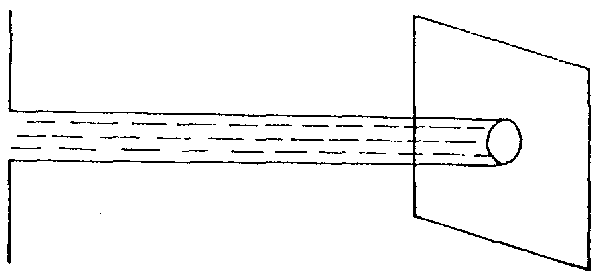
Through a narrow slit—or a small circular opening, we may assume to begin with—in an otherwise opaque wall, we let in light (Figure IIb). We let the light pour in through the slit. Opposite the wall through which the light is pouring in, we put a screen. By virtue of the light that is pouring in, we see an illuminated circular surface on the screen. The experiment is best done by cutting a hole in the shutters, letting the sunlight pour in from outside. We can then put up a screen and catch the resulting picture. We cannot do it in this way; so we are using the lantern to project it. When I remove the shutter, you see a luminous circle on the wall. This, to begin with, is the picture which arises, in that a cylinder of light, passing along here, is caught on the opposite wall. We now put a “prism” into the path of this cylinder of light (Figure IIc).
The light can then no longer simply penetrate to the opposite wall and there produce a luminous circle; it is compelled to deviate from its path. How have we brought this about? The prism is made of two planes of glass, set at an angle to form a wedge. This hollow prism is then filled with water. We let the cylinder of light, produced by the projecting apparatus, pass through the water-prism. If you now look at the wall, you see that the patch of light is no longer down there, where it was before. It is displaced,—it appears elsewhere. Moreover you see a peculiar phenomenon:—at the upper edge of it you see a bluish-greenish light. You see the patch with a bluish edge therefore. Below, you see the edge is reddish-yellow.
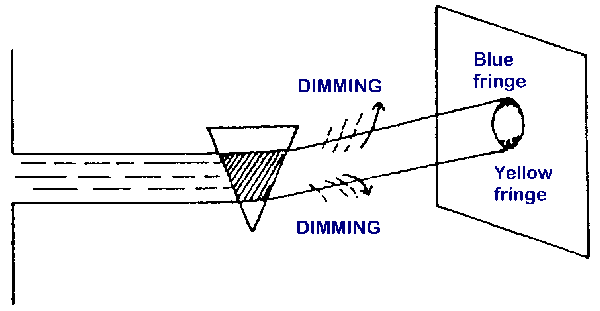
This then is what we have to begin with,—this is the “phenomenon”. Let us first hold to the phenomenon, simply describing the fact as it confronts us. In going through the prism, the light is somehow deflected from its path. It now forms a circle away up there, but if we measured it we should find it is not an exact circle. It is drawn out a little above and below, and edged with blue above and yellowish below. If therefore we cause such a cylinder of light to pass through the prismatically formed body of water,—neglecting, as we can in this case, whatever modifications may be due to the plates of glass—phenomena of colour arise at the edges.
Now I will do the experiment again with a far narrower cylinder of light. You see a far smaller patch of light on the screen. Deflecting it again with the help of the prism, once more you see the patch of light displaced,—moved upward. This time however the circle of light is completely filled with colours, The displaced patch of light now appears violet, blue, green, yellow and red, Indeed, if we made a more thorough study of it, we should find in it all the colours of the rainbow in their proper order. We take the fact, purely and simply as we find it; and please—all those of you who learned at school the neatly finished diagrams with rays of light, normals and so on,—please to forget them now. Hold to the simple phenomenon, the pure and simple fact. We see colours arising in and about the light and we can ask ourselves, what is it due to? Look please once more; I will again insert the larger aperture. There is again the cylinder of light passing through space, impinging on the screen and there forming its picture of light (Figure IIb). Again we put the prism in the way. Again the picture of light is displaced and the phenomena of colour appear at the edges (Figure IIc).
Now please observe the following. We will remain purely within the given facts. Kindly observe. If you could look at it more exactly you would see the luminous cylinder of water where the light is going through the prism. This is a matter of simple fact: the cylinder of light goes through the prism of water and there is thus an interpenetration of the light with the water. Pay careful attention please, once more. In that the cylinder of light goes through the water, the light and the water interpenetrate, and this is evidently not without effect for the environment. On the contrary, we must aver (and once again, we add nothing to the facts in saying this):—the cylinder of light somehow has power to make its way through the water-prism to the other side, yet in the process it is deflected by the prism. Were it not for the prism, it would go straight on, but it is now thrown upward and deflected. Here then is something that deflects our cylinder of light. To denote this that is deflecting our cylinder of light by an arrow in the diagram, I shall have to put the arrow thus. So we can say, adhering once again to the facts and not indulging in speculations: By such a prism the cylinder of light is deflected upward, and we can indicate the direction in which it is deflected.
And now, to add to all this, think of the following, which once again is a simple statement of fact. If you let light go through a dim and milky glass or through any cloudy fluid—through dim, cloudy, turbid matter in effect,—the light is weakened, naturally. When you see the light through clear unclouded water, you see it in full brightness; if the water is cloudy, you see it weakened. By dim and cloudy media the light is weakened; you will see this in countless instances. We have to state this, to begin with, simply as a fact. Now in some respect, however little, every material medium is dim. So is this prism here. It always dims the light to some extent. That is to say, with respect to the light that is there within the prism, we are dealing with a light that is somehow dimmed. Here to begin with (pointing to Figure IIc) we have the light as it shines forth; here on the other hand we have the light that has made its way through the material medium. In here however, inside the prism, we have a working-together of matter and light; a dimming of the light arises here. That the dimming of the light has a real effect, you can tell from the simple fact that when you look into light through a dim or cloudy medium you see something more. The dimming has an effect,—this is perceptible. What is it that comes about by the dimming of the light? We have to do not only with the cone of light that is here bent and deflected, but also with this new factor—the dimming of the light, brought about by matter. We can imagine therefore into this space beyond the prism not only the light is shining, but there shines in, there rays into the light the quality of dimness that is in the prism. How then does it ray in? Naturally it spreads out and extends after the light has gone through the prism. What has been dimmed and darkened, rays into what is light and bright. You need only think of it properly and you will admit: the dimness too is shining up into this region. If what is light is deflected upward, then what is dim is deflected upward too. That is to say, the dimming is deflected upward in the same direction as the light is. The light that is deflected upward has a dimming effect, so to speak, sent after it. Up there, the light cannot spread out unimpaired, but into it the darkening, the dimming effect is sent after. Here then we are dealing with the interaction of two things: the brightly shining light, itself deflected, and then the sending into it of the darkening effect that is poured into this shining light. Only the dimming and darkening effect is here deflected in the same direction as the light is. And now you see the outcome. Here in this upward region the bright light is infused and irradiated with dimness, and by this means the dark or bluish colours are produced.
How is it then when you look further down? The dimming and darkening shines downward too, naturally. But you see how it is. Whilst here there is a part of the outraying light where the dimming effect takes the same direction as the light that surges through—so to speak—with its prime force and momentum, here on the other hand the dimming effect that has arisen spreads and shines further, so that there is a space for which the cylinder of light as a whole is still diverted upward, yet at the same time, into the body of light which is thus diverted upward, the dimming and darkening effect rays in. Here is a region where, through the upper parts of the prism, the dimming and darkening goes downward. Here therefore we have a region where the darkening is deflected in the opposite sense,—opposite to the deflection of the light. Up there, the dimming or darkening tends to go into the light; down here, the working of the light is such that the deflection of it works in an opposite direction to the deflection of the dimming, darkening effect. This, then, is the result:—Above, the dimming effect is deflected in the same sense as the light; thus in a way they work together. The dimming and darkening gets into the light like a parasite and mingles with it. Down here on the contrary, the dimming rays back into the light but is overwhelmed and as it were suppressed by the latter. Here therefore, even in the battle between bright and dim—between the lightening and darkening—the light predominates. The consequences of this battle—the consequences of the mutual opposition of the light and dark, and of the dark being irradiated by the light, are in this downward region the red or yellow colours. So therefore we may say: Upward, the darkening runs into the light and there arise the blue shades of colour; downward, the light outdoes and overwhelms the darkness and there arise the yellow shades of colour.
You see, dear Friends: simply through the fact that the prism on the one hand deflects the full bright cone of light and on the other hand also deflects the dimming of it, we have the two kinds of entry of the dimming or darkening into the light,—the two kinds of interplay between them. We have an interplay of dark and light, not getting mixed to give a grey but remaining mutually independent in their activity. Only at the one pole they remain active in such a way that the darkness comes to expression as darkness even within the light, whilst at the other pole the darkening stems itself against the light, it remains there and independent, it is true, but the light overwhelms and outdoes it. So there arise the lighter shades,—all that is yellowish in colour. Thus by adhering to the plain facts and simply taking what is given, purely from what you see you have the possibility of understanding why yellowish colours on the one hand and bluish colours on the other make their appearance. At the same time you see that the material prism plays an essential part in the arising of the colours. For it is through the prism that it happens, namely that on the one hand the dimming is deflected in the same direction as the cone of light, while on the other hand, because the prism lets its darkness ray there too, this that rays on and the light that is deflected cut across each other. For that is how the deflection works down here. Downward, the darkness and the light are interacting in a different way than upward.
Colours therefore arise where dark and light work together. This is what I desired to make clear to you today. Now if you want to consider for yourselves, how you will best understand it, you need only think for instance of how differently your own etheric body is inserted into your muscles and into your eyes. Into a muscle it is so inserted as to blend with the functions of the muscle; not so into the eye. The eye being very isolated, here the etheric body is not inserted into the physical apparatus in the same way, but remains comparatively independent. Consequently, the astral body can come into very intimate union with the portion of the etheric body that is in the eye. Inside the eye our astral body is more independent, and independent in a different way than in the rest of our physical organization. Let this be the part of the physical organization in a muscle, and this the physical organization of the eye. To describe it we must say: our astral body is inserted into both, but in a very different way. Into the muscle it is so inserted that it goes through the same space as the physical bodily part and is by no means independent. In the eye too it is inserted: here however it works independently. The space is filled by both, in both cases, but in the one case the ingredients work independently while in the other they do not. It is but half the truth to say that our astral body is there in our physical body. We must ask how it is in it, for it is in it differently in the eye and in the muscle. In the eye it is relatively independent, and yet it is in it,—no less than in the muscle. You see from this: ingredients can interpenetrate each other and still be independent. So too, you can unite light and dark to get grey; then they are interpenetrating like astral body and muscle. Or on the other hand light and dark can so interpenetrate as to retain their several independence; then they are interpenetrating as do the astral body and the physical organization in the eye. In the one instance, grey arises; in the other, colour. When they interpenetrate like the astral body and the muscle, grey arises; whilst when they interpenetrate like the astral body and the eye, colour arises, since they remain relatively independent in spite of being there in the same space.